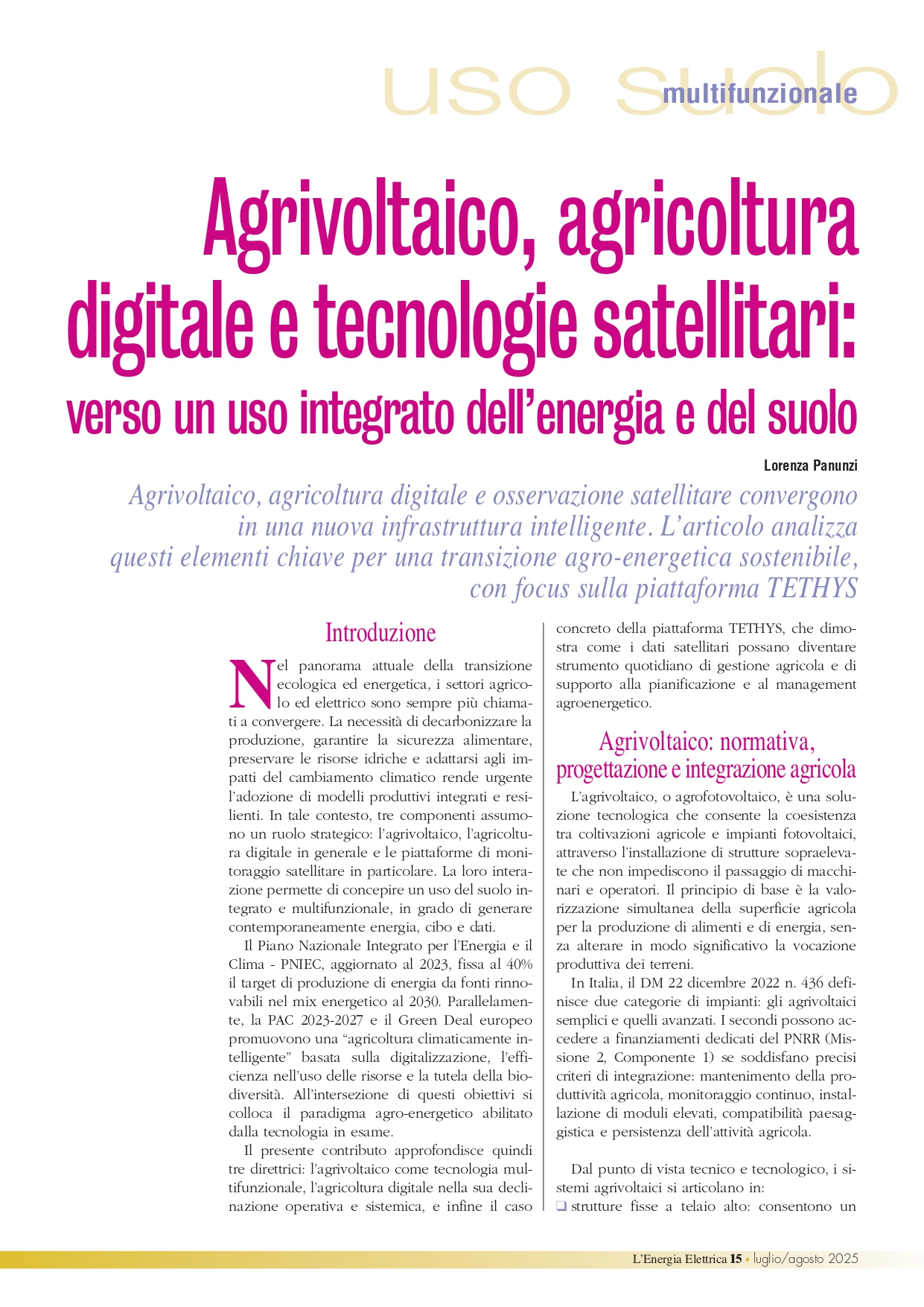
It was published in the magazine Electricity (July/August 2025) the article signed by Lorenza Panunzi which explores how agrivoltaic, digital agriculture and satellite observation can be integrated into a single intelligent infrastructure of the territory, capable of produce energy, food and data sustainably.
Why agriculture and energy must converge
Climate change, water scarcity and decarbonisation targets make a new vision is neededAgriculture and energy, two historically separate sectors, are today called to dialogue and build integrated production models.
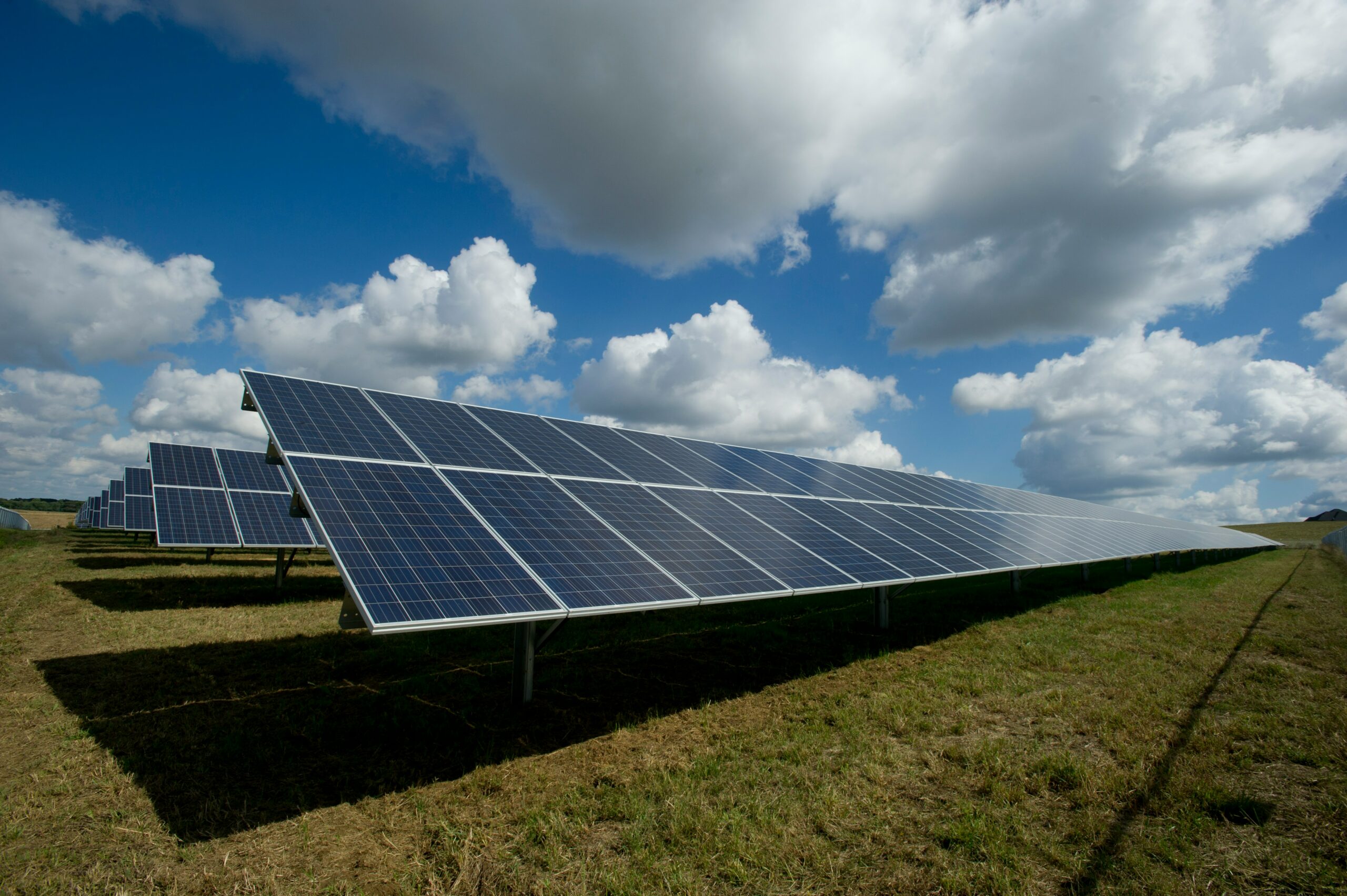
Agrivoltaics: energy and crops together
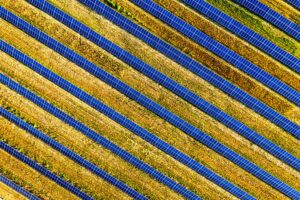
Agrivoltaics allows you to grow and produce solar energy in the same space, thanks to elevated structures that do not impede agricultural activities. In Italy it is regulated by Ministerial Decree 436/2022 and the more recent Ministerial Decree on Agrivoltaics of 2023, with stringent requirements: maintaining agricultural productivity, continuous monitoring, high modules and landscape compatibility.
These solutions can improve land use and, in some cases, even agricultural yields thanks to controlled shading that reduces thermal and water stress. However, there remain challenges with regards to authorization and social acceptance, where objective data becomes crucial.
Digital Agriculture: Data for Better Decisions
Digital agriculture, or 4.0, integrates sensors, artificial intelligence and cloud platforms to optimize resources, increase productivity and reduce environmental impact. Today in Italy the market exceeds 2.3 billion euros, but its diffusion is still limited to more structured companies.
The most widespread applications include:
• Decision support systems (irrigation, defense, sowing)
• Management software for traceability
• Vigour and productivity maps from satellites
Challenges and opportunities intertwine: access to technologies, interoperability of platforms, data governance.
The role of precision agriculture in agrivoltaics
The national guidelines reiterate the importance of precision farming techniques to optimize yields and reduce inputs. Concrete benefits: more efficient water use, reduced use of fertilizers and pesticides, early detection of plant diseases, more targeted harvests. Digitalisation is therefore confirmed as a ally to make agrivoltaic systems sustainable and objectively monitorable.
TETHYS: satellite observation without ground sensors
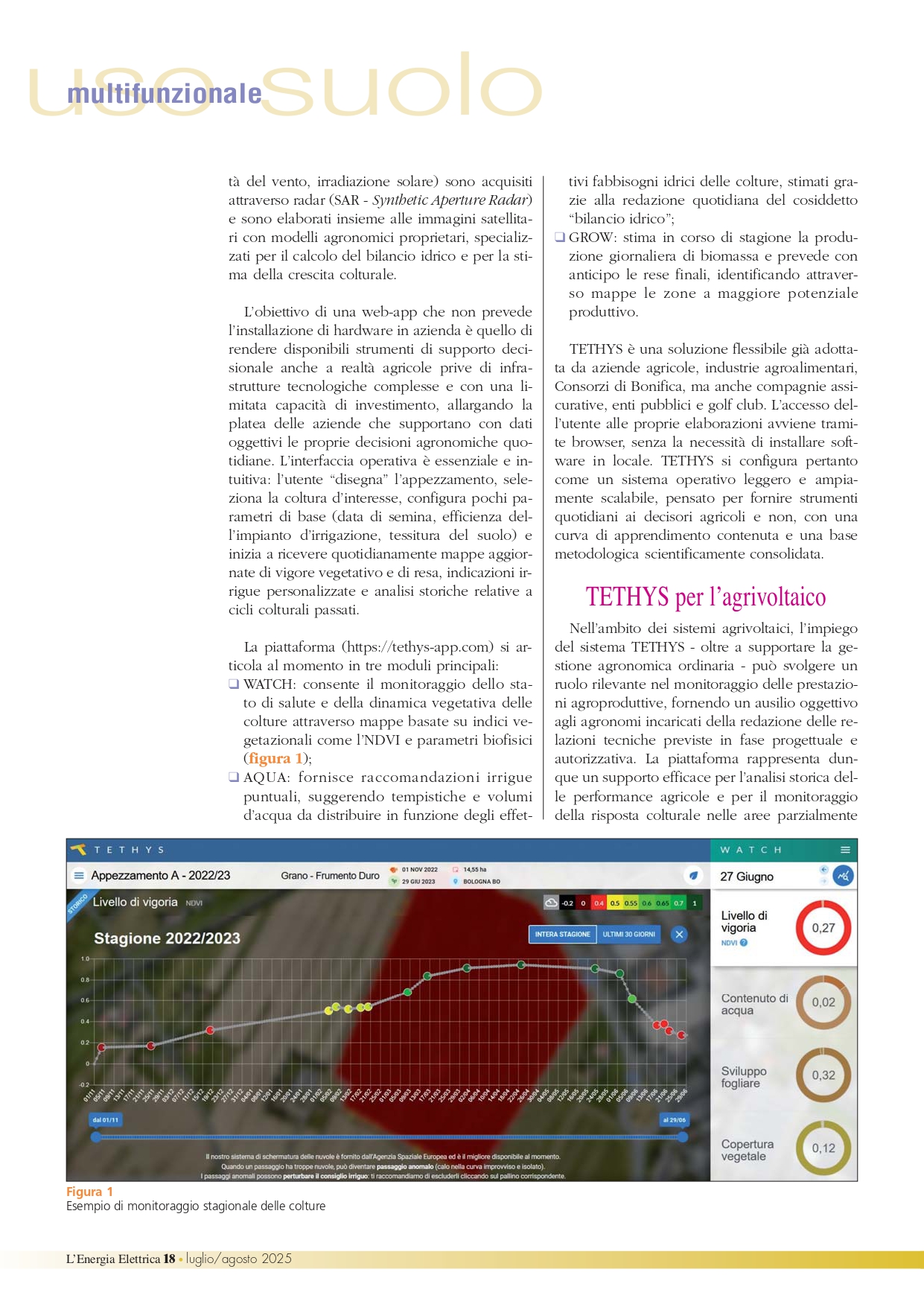
TETHYS brings satellite observation to the service of agricultural companies without the need to install sensors in the field. The information comes from multispectral satellite imagery (Sentinel 2 and Landsat 8 and 9) and proprietary agronomic models.
Already adopted by agricultural companies, land reclamation consortia and agri-food industries, TETHYS is accessible via browser and designed to be simple, scalable and scientifically sound.
TETHYS for agrivoltaics
In agrivoltaic systems, TETHYS is a key tool for:
• Demonstrate the crop continuity
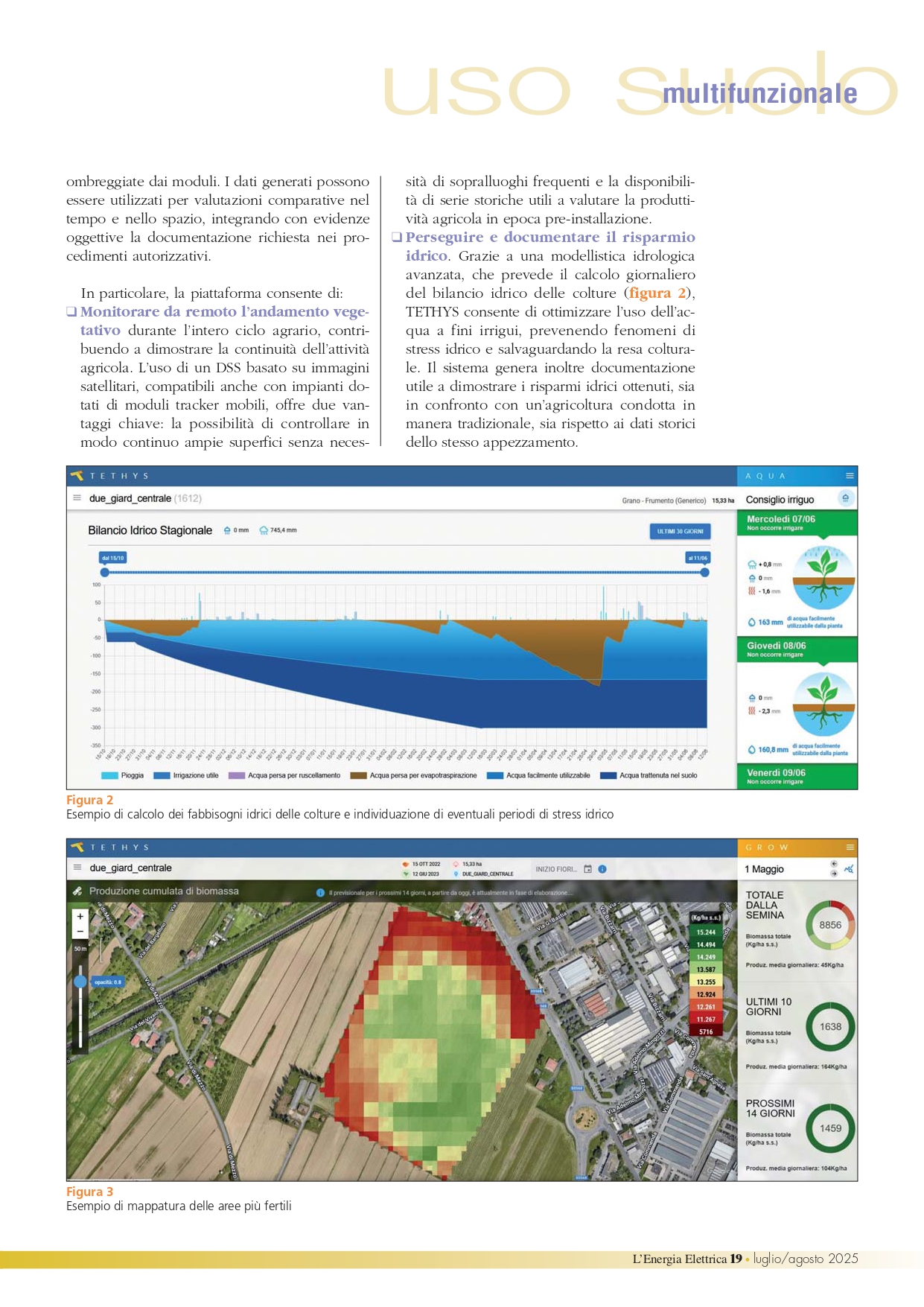
• Document the water savings
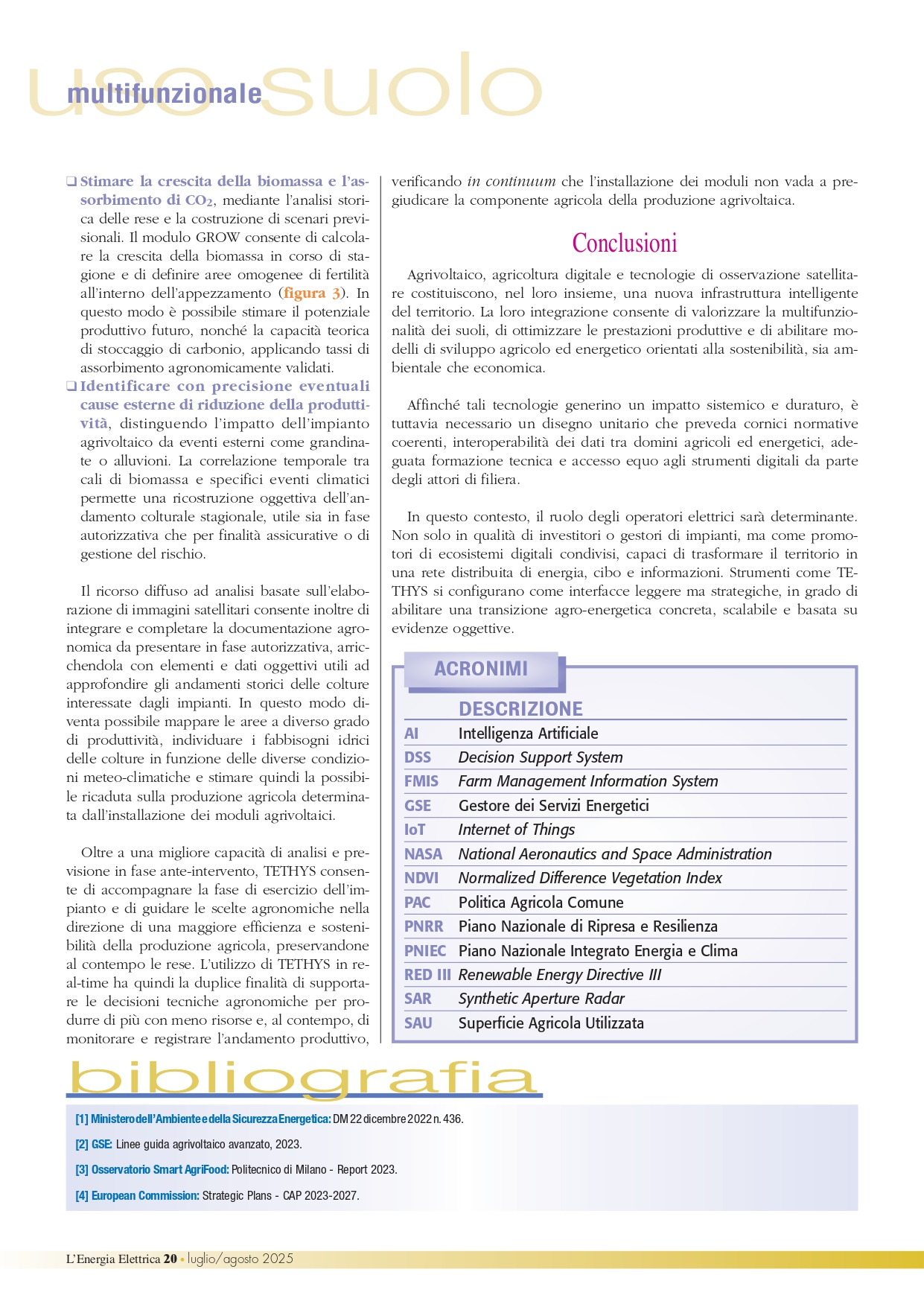
• Estimate biomass growth andCO₂ absorption,
• Distinguish plant impacts from extreme weather events.
This approach allows for integrate objective data into authorization procedures and of accompany the entire life cycle of the systems, from project to operational management.
Agrivoltaics, digital agriculture and satellite observation constitute a new intelligent infrastructure for the territory. Their integration can enhance the multifunctionality of soils and support scalable and sustainable production models, both in agriculture and energy.
Instruments such as TETHYS represent thelight but strategic interface to enable this transition: concrete, measurable, evidence-based.
Why does Agriculture 4.0 struggle to take off in the field? Often, the problem isn't the technology, but the excess of raw data, the dependence on expensive hardware... Continue reading
Heat and drought are no longer conditions to be addressed only in emergencies. Satellite data helps monitor crops and plan irrigation accordingly... Continue reading
A new agrivoltaic project with Syniergy integrates crops, water management, and TETHYS monitoring across approximately 20 hectares in the province of Bologna. Continue reading
Can satellite monitoring accurately estimate kiwifruit's water needs? Analyses conducted in Calabria confirm the reliability of the TETHYS model. Continue reading