

The project
Launched in 2024, the research project on kiwifruit decline continues crop analysis and monitoring activities Actinidia in Lazio and Calabria.
Funded by Elle Esse AOP within the Operational Programme of the CMO of Emilia-Romagna and implemented by TETHYS in collaboration with theUniversity of Calabria, University of Naples and some agricultural companies in the Pontine area, the project aims to identify the environmental and agronomic factors that contribute to the onset of the so-called kiwifruit decline.
The goal is to define a continuous and objective monitoring system for vegetative growth and soil moisture, to help producers prevent water and root stress that can lead to kiwifruit decline.
The previous stages
The project was launched in 2024 and presented in the opening article The CMO kiwifruit decline project: a step forward in innovation, who illustrated the objectives and working methodology, based on the integration of the modules WATCH And WATER for the satellite monitoring and the water balance.
In the following months, thewinter update he described the first elaborations on soil humidity, with theidentification of areas subject to water stagnation, while thesummer update documented the vegetative evolution of crops and the differences between covered and uncovered plots, with an initial evaluation on theimpact of hail covers on plant water requirements.
Activities in 2025
During an update meeting between the project partners, TETHYS presented the results of the activities carried out in the first ten months of 2025.
The work focused on three lines of analysis: the vegetative state of crops, the seasonal water balance, and winter monitoring of soil moisture.
Vegetative state monitoring
Through the form WATCH, they were vegetative vigor indices constantly monitored (NDVI) of the six study plots.
The anomalies identified during the season were verified in two phases: first to exclude any atmospheric effects not detected by the system (haze or cloud cover), then with a visual inspection in the field by the producers.
To date, no significant critical issues have been found and the indices show a trend consistent with the physiology of the plants.
Water balance analysis
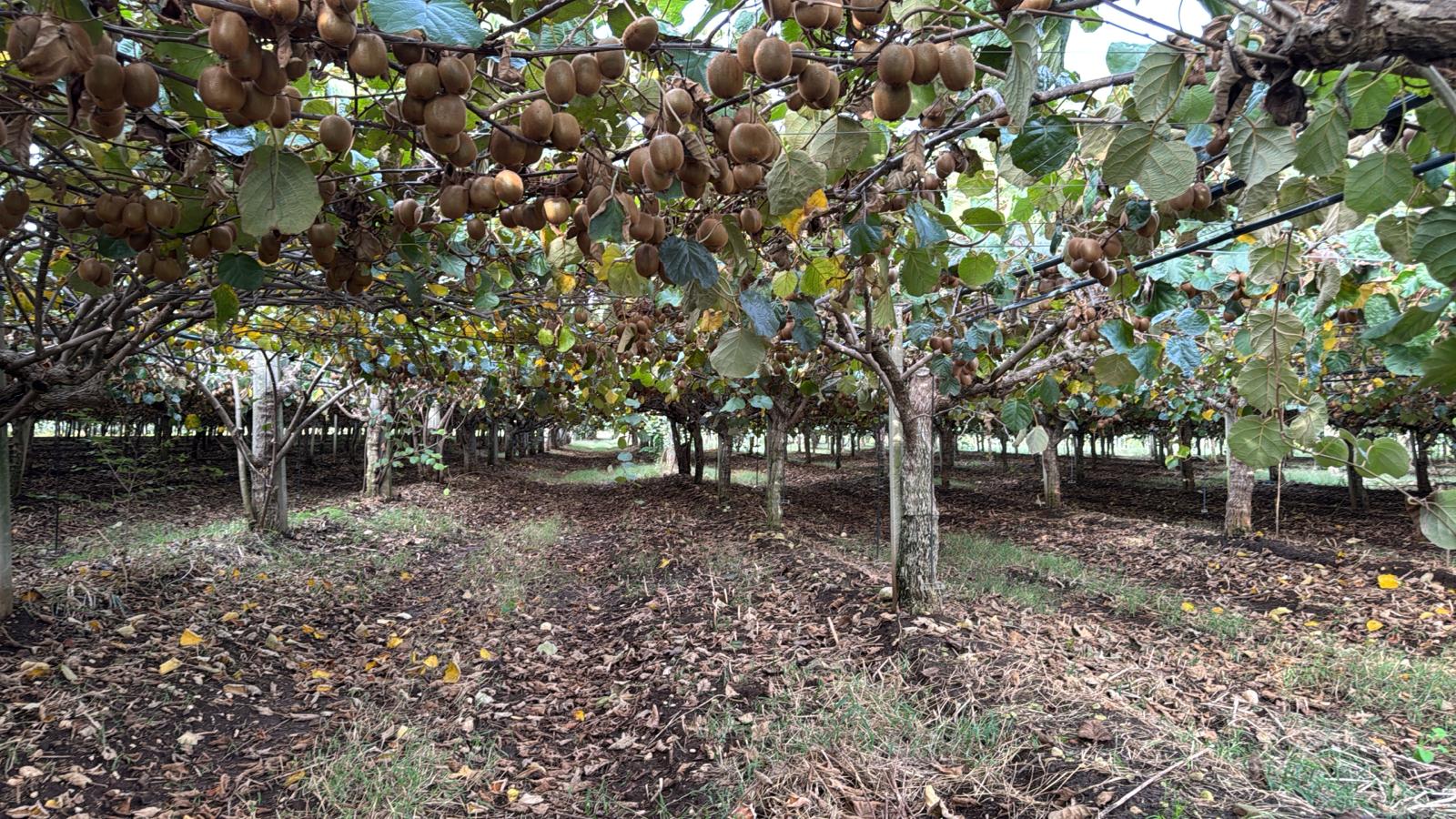
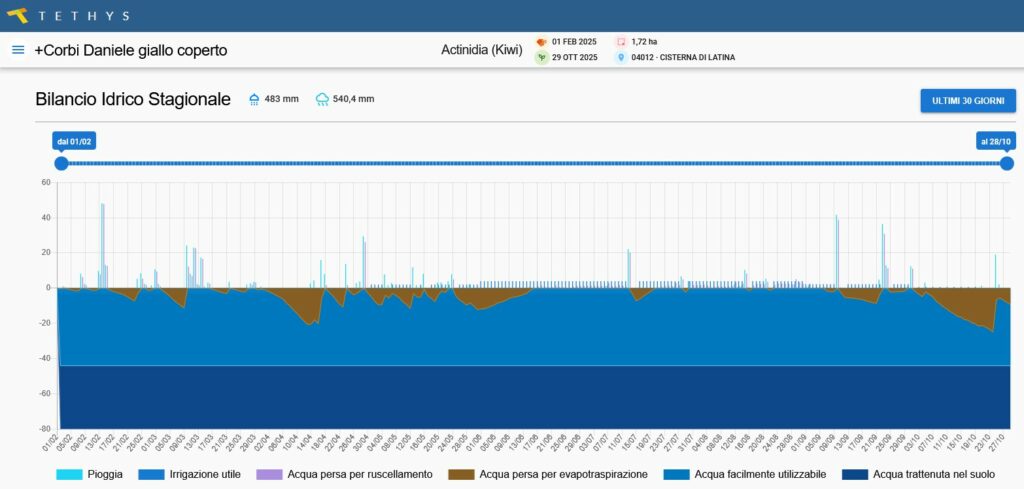
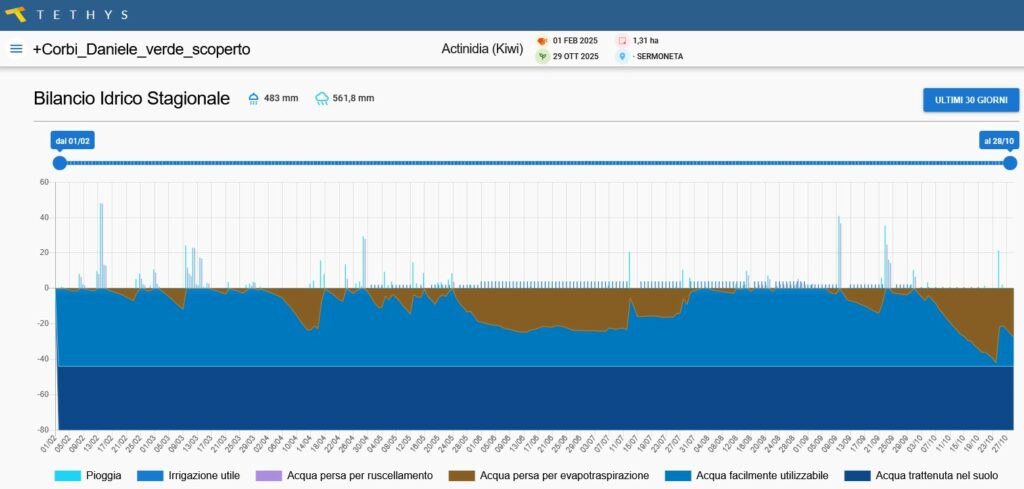
The processing of the form WATER have affected two plots of land to dateDaniele Corbi farm in Sermoneta (LT), specialized in the production of green and yellow kiwifruit.
The comparison between the actual irrigation volumes and the needs estimated by AQUA highlighted a slight over-irrigation in the uncovered plot and a more marked excess in the one covered by anti-hail netting, where evapotranspiration is naturally lower.
In both cases, however, no symptoms of decline or root stress were observed, a sign that the excess water did not produce agronomically significant effects.
Winter soil moisture monitoring
During the period between January and March 2025, the cumulative real evapotranspiration of a plot of approximately six hectares of theMauro Guzzo company in Borgo Montello (LT), grown with Hayward kiwifruit and without hail cover.
The processing has highlighted three areas with anomalous evapotranspiration values, potentially attributable to water stagnation phenomena.
The identified areas will be subject to field verification, with the aim of validating the satellite analyses and improving the calibration of the hydrological model.
Perspectives
Activities will continue in 2026 with the'extending monitoring to a greater number of farms and correlating water and vegetative data with productivity and mortality indicators.
The ultimate goal is Develop predictive tools for irrigation management and prevention of kiwifruit decline, to support more sustainable and resilient fruit growing.