

The continuation continues collaboration between TETHYS and Syniergy for the development of agrivoltaic projects in which energy production and agricultural activity are integrated right from the start design phase.
After the project already described in the article Agricultural production increases with satellite data and agrivoltaics, dedicated to the ex ante satellite analysis of another agricultural area in the province of Bologna intended for a mobile tracker agrivoltaic system, a new intervention confirms the same direction of work: to build systems in which agricultural continuity is designed, managed and measured over time.
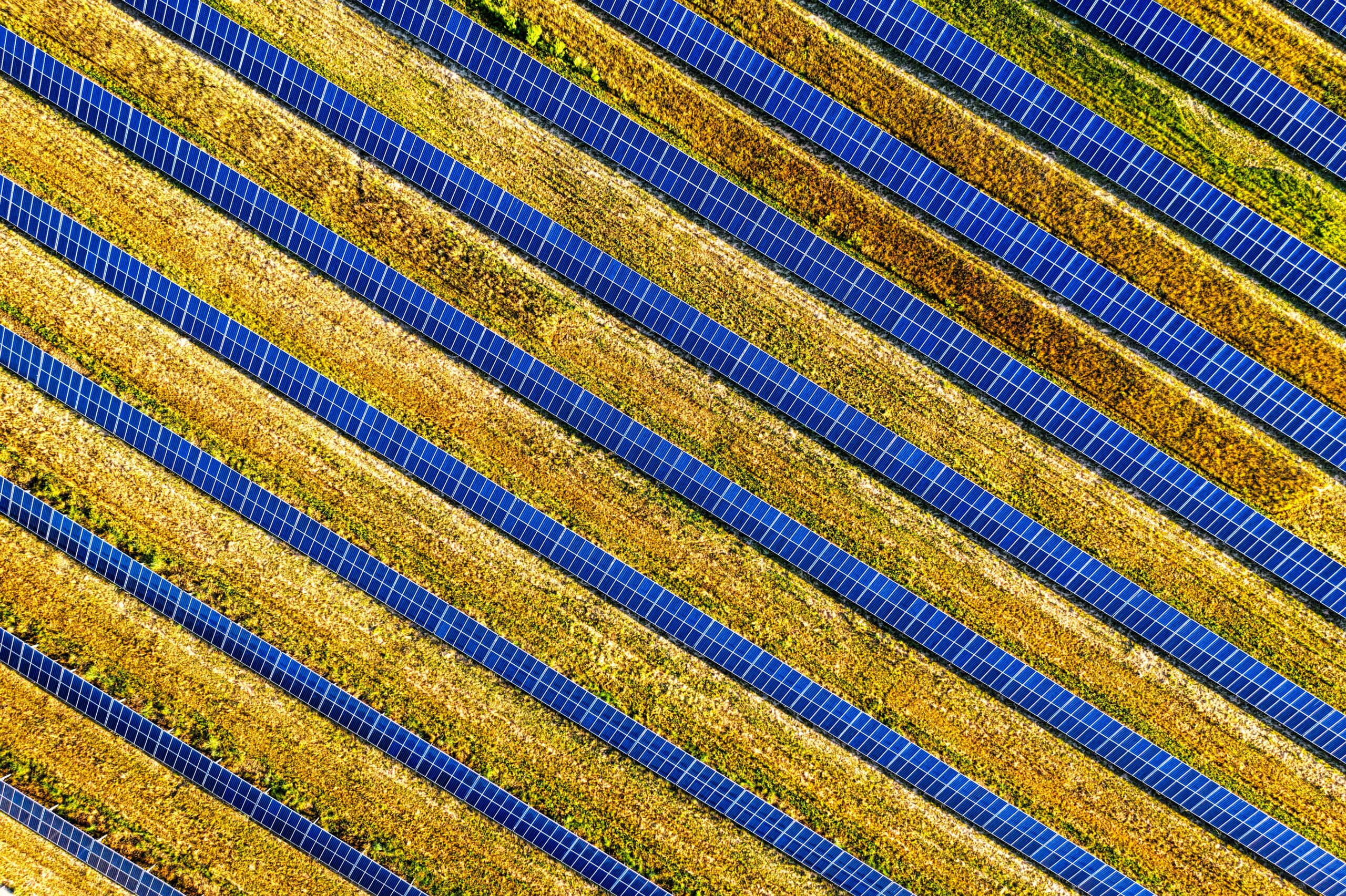
The new project involves a gross surface area of approximately 20 hectares, always in the province of Bologna. Theagricultural activity will continue to be practiced within the plant area and will affect approximately 80% of the total surface area, with a reduction of approximately 20% compared to the initial situation. crops They will be distributed in the free spaces between the rows of structures and in the areas between the modules and the fence, where accessibility and maneuverability of agricultural vehicles will be guaranteed.
Agrivoltaics and agricultural continuity
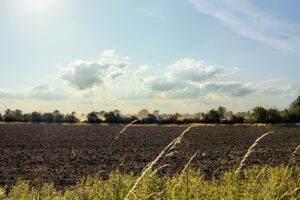
The area has recently been affected by the cultivation of arable land, which will also be maintained in the post-operation configuration. The choice allows you to preserve the agricultural vocation of the site, inserting the agrivoltaic system inside a cultivation path already consistent with the territory.
The agronomic plan includes a three-year rotation, designed to alternate impoverishing, preparatory and improving crops. This step is important because it allows protect soil fertility over time and to maintain balanced agricultural management even in the new layout of the area.
In an agrivoltaic project, agricultural continuity cannot be assessed solely in terms of cultivated area. It also depends on how that area is managed, the consistency of rotations, the choice of crops, the sustainability of inputs, and the ability to maintain an orderly, productive and documentable agricultural activity over time.
Crops, shading and new production structure
The definition of the agronomic plan took into account the conditions generated by the presence of the plant, starting from a shading Estimated at around 30% compared to the initial situation. Therefore, the choice of crops was evaluated based on tolerance to lower solar radiation, plant height, and local climate requirements.
The presence of the modules can modify the microclimate of the area and, for some crops, generate favorable conditions. Partial shading can help protect plants from hail, strong winds, and excessive radiation, while reduced sun exposure can reduce evaporation from the soil and contain water stress.
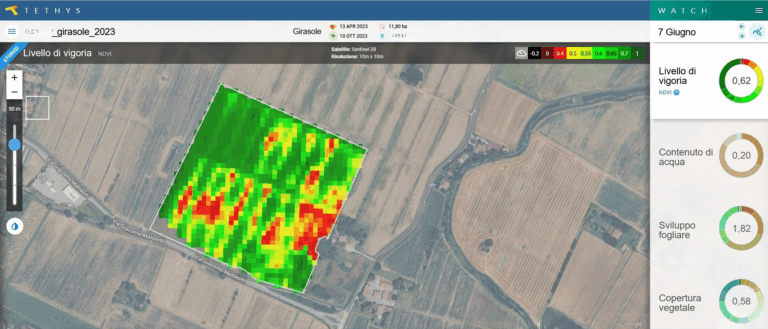
These are particularly relevant aspects in a climatic phase in which the water management and the crop protection they are becoming increasingly decisive elementsIn this context, agrivoltaics can offer an advantage only if the energy planning is accompanied by a rigorous agronomic evaluation and tools capable of verifying the response of crops over time.
The role of TETHYS in agronomic management
The reduction in cultivated area will be compensated by an increase in unit profitability of crops in the post-operation situationThe plan includes the use of higher value-added varieties, the possibility of a second crop, and the use of TETHYS technology to support agronomic management.
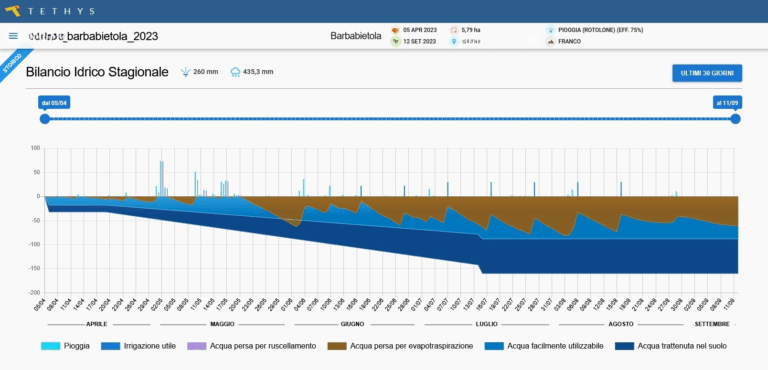
In particular, TETHYS, with the module WATER, will be used for the irrigation calendar management, which will be set on the basis of the actual water needs of the crops. water balance It will be calculated daily, allowing irrigation interventions to be planned more precisely than the pre-operation situation.
This approach could generate a water savings estimated between 20% and 25%, with benefits from both an environmental and economic point of view. The water management It therefore becomes one of the central elements of the project, together with agricultural continuity and the measurability of performance over time.
Environmental mitigation and landscape integration
The project also includes the construction of a perimeter mitigation zone along the entire perimeter of the planting area. They will be planted over 2,000 shrubs and trees of different heights, selected in accordance with the local vegetation context.
The strip will have the function of masking the fence and the agrivoltaic field, while at the same time promoting a greater naturalness of the areaThe use of native trees and shrubs, together with a variety of plant species, will allow us to obtain a differentiated shielding and a more harmonious insertion of the system into the surrounding landscape.
This element also contributes to viewing agrivoltaics as a comprehensive project, in which energy production, agricultural activity, soil protection, water management, and environmental mitigation must proceed in a coordinated manner.
A new step in the collaboration between TETHYS and Syniergy
The new project in the province of Bologna strengthens the path started by TETHYS and Syniergy in Development of agrivoltaic systems based on data, agronomic analysis and continuous monitoring.
Agricultural continuity is achieved through a cultivation plan compatible with the new layout of the area, irrigation management based on the actual needs of the crops, and careful design of the system's environmental integration.
In this perspective, theagrivoltaic it is not only an energy solution applied to agricultural land, but a system to be designed and verified over timeThis is where TETHYS's contribution becomes central: making the agricultural evolution of the system measurable, supporting technical decisions, and providing objective data to document the project's sustainability.