


From 4 to 6 March 2026 the Rimini Expo Center hosted a new edition of Key Energy – The Energy Transition Expo, one of the main European events dedicated to energy transition.
TETHYS was represented by Lorenza Panunzi, which over the course of the three days collected impressions, observations and comparisons with sector operators, returning the image of a well-attended fair and growing compared to last year.
In this context agrivoltaics has confirmed itself as one of the most present topics in the debate between planners, developers, and energy operators. At the same time, it became clear a phase of strong regulatory uncertainty, which accompanies the growth of the sector.
A growing sector, but with still uncertain contours
If interest in agrivoltaics continues to increase, the regulatory framework still appears evolving.
According to the impressions gathered during the fair, many operators perceive a certain ambiguity between the new legislation and the existing guidelines, which in some passages result difficult to interpret or to be applied consistently.
In particular, several aspects related to the agricultural component of the plants, including how this should be monitored and demonstrated over time.
It is precisely on this ground that an important part of the debate between operators is concentrated today, because agrivoltaics is not only an energy technology but a system that must credibly integrate agricultural production and energy.
The interest of the operators who manage the plants
During the discussions at the fair, an interesting element also emerged regarding the positioning of instruments such as TETHYS.
The greatest interest came above all from small to medium-sized businesses, Often directly involved in operational management of agrivoltaic systems.
These are subjects who they deal with the agricultural management of the surfaces on a daily basis and with the need to monitor crop response, water use and vegetative growth over time.
In this context, the availability of objective data and continuous observation tools becomes a fundamental condition for transforming the integration between agriculture and energy into a verifiable process and not just declared.
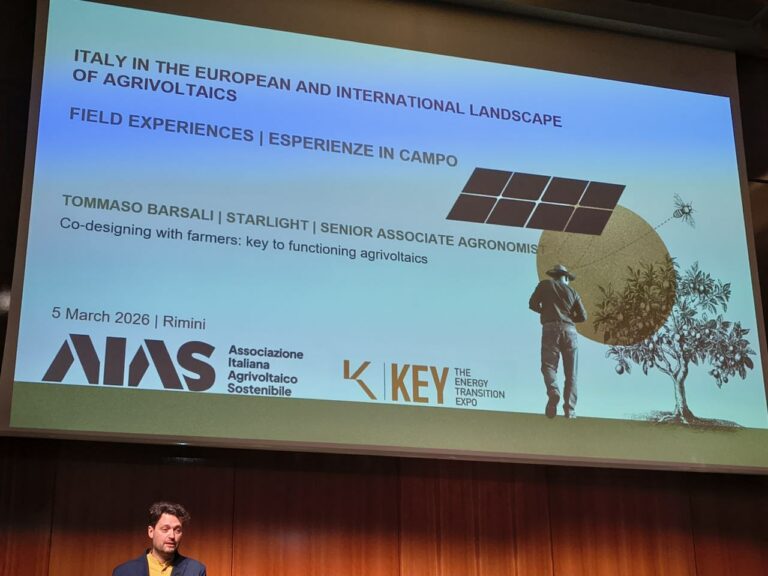
A discussion with AIAS on Italy's role in agrivoltaics
Among the meetings attended during the fair, Lorenza Panunzi also attended the event organised by AIAS – Italian Sustainable Agrivoltaics Association, dedicated to the Italy's role in the European and international agrivoltaic landscape.
The comparison highlighted how, despite the operational and regulatory difficulties, Italy is today considered one of the reference countries for the development of this model, also thanks to the opportunities created by the measures of the PNRR.
The meeting addressed various aspects of the sector, from regulatory framework to the market, up to the themes of thesocial acceptability, from the research and of the operational experiences matured in the field.
The reference to concrete experiences has highlighted how agrivoltaics is progressively moving from an experimental field to an operational sphere, where plant management becomes a central issue.
Data and quality in the life cycle of plants
Another moment of comparison was the meeting organized by Synergy together with TÜV Italia, entitled “Quality, data, and innovation for renewable and intelligent energy sources”.
The seminar addressed the issue of the growing complexity of energy assets and the need for integrate design, data management and performance control throughout the entire life cycle of the systems.
During the interventions it emerged that the energy transition requires increasingly integrated systems and processes capable of combine engineering, independent verification and asset digitization.
In this scenario, the availability of reliable data and of structured monitoring tools becomes a decisive element not only to improve the quality of projects, but also to make more transparent and verifiable plant management over time.
A comparison that looks at management over time
The impressions collected at Key Energy therefore give the image of a dynamic and expanding sector, but also crossed by still open questions.
Among these, one of the most relevant concerns the ability to observe and document the agricultural component of agrivoltaic systems over time.
In a context where sustainability cannot be simply declared but must be demonstrated through data, continuous observation and reliable monitoring methods, the dialogue between agronomy, technology and energy asset management is becoming increasingly central.