

There water management continues to be one of the central aspects of the research on kiwi cultivation. From 2023 TETHYS will participate in a study and monitoring path born to explore the possible relationships between irrigation management, crop conditions and kiwifruit die-off, a phenomenon that represents a serious criticality for many agricultural companies.
Over the years, the activities have progressively expanded, combining the monitoring of the vegetative state with the analysis of water needs and the evaluation of the possibilities of Optimize irrigation using satellite data.
The experimentation will continue in 2026 in Calabria, where the new TETHYS Aqua analyses highlight a significant result: compared to the volumes of water actually distributed by farmers, with TETHYS it would have been possible to obtain water savings greater than 25%.
Kiwi monitoring continues on the Adornato farm's plots.
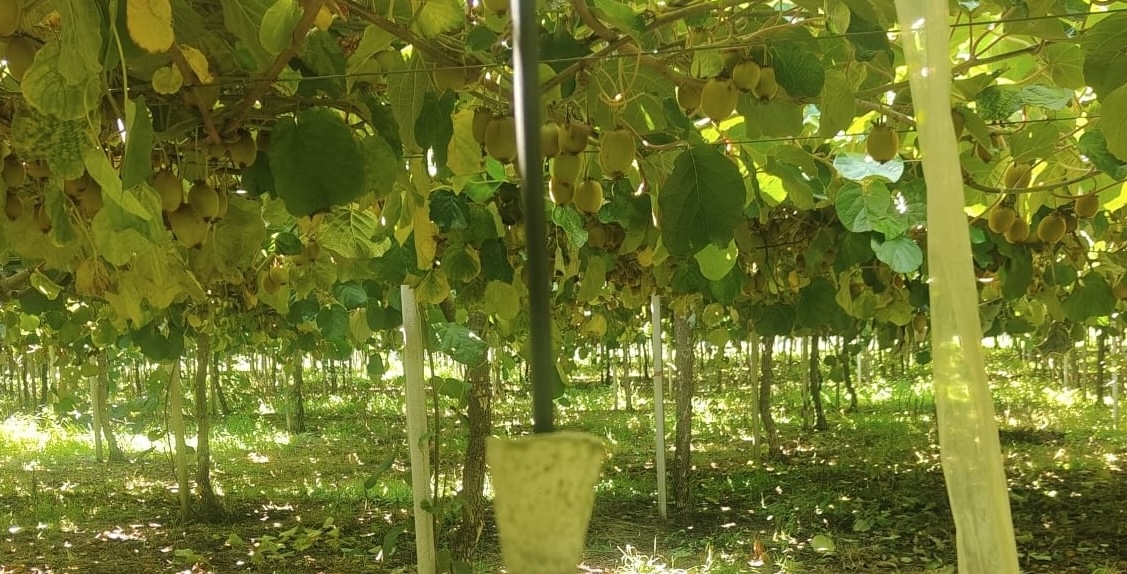
As already told in the previous update, the experiment is taking place in Polistena, in the province of Reggio Calabria, on two adjacent plots of land belonging to the Adornato Agricultural Company.
The first, of about 1.5 hectares, is cultivated with yellow kiwi of the Gold G3 variety, while the second, of about 1.2 hectares, hosts plants of Hayward green kiwi.
Even in 2026 TETHYS continued the’Analysis of crop water needs through satellite monitoring, developing the water balance on the basis of evapotranspiration and natural contributions due to precipitation.
The analyses are part of the scientific collaboration with Prof. Gullo and Dr. Dattola of the’University of Calabria, engaged in studying the same plots through measurements taken directly on the plants using Sap Flow sensors.
The data processed by TETHYS are consistent with those obtained through field measurements, offering a further element of comparison within the research activities.
Kiwi irrigation: how much could have been saved in 2026?
The most interesting result of the 2026 season emerges from the comparison between the volumes of water actually used by farmers and those that would have been necessary according to the estimates drawn up by the service TETHYS Aqua.
During the growing season, farmers distributed approximately 20,000 liters of water per plant. satellite analysis instead they indicate that it would have been possible to meet the irrigation needs of the crops using less than 15,000 litres per plant.
The difference corresponds to a potential water saving greater than 25%, without this implying a reduction in the water needed by plants according to the model's estimates.
This data highlights the impact of irrigation planning based on the actual needs of crops, especially in a crop like kiwifruit, which is particularly sensitive to water imbalances.
Through TETHYS Aqua, irrigation interventions can be planned taking into account the trend of evapotranspiration, rainfall and crop needs, with the’aim of limiting unnecessary water supplies.
From 2025 to 2026, how the potential water savings will change
The comparison with the previous season offers further indication of the importance of adapting irrigation management to climatic conditions.
In 2025, TETHYS analyses had highlighted a potential water saving higher than 50%, while in 2026 the estimated margin is higher than 25%.
This difference can also be interpreted in light of weather conditions, which directly impact crop needs. In warmer, drier seasons, increased evapotranspiration demand can require greater irrigation inputs, reducing the potential for savings compared to years with different conditions.
The result therefore confirms the usefulness of irrigation management that is not based on pre-established quantities of water., but is capable of adapting to the conditions of the season and the needs of the plants.
Tethys Aqua and the value of satellite data for kiwi cultivation
The experiment conducted in Calabria adds a new element to the research path that TETHYS has been carrying out for several years on kiwi cultivation and water resource management.
The use of satellite data allows us to estimate crop needs and to support the planning of irrigation interventions without requiring the installation of sensors directly in the plots.
Thanks to DSS, the information collected is translated into operational instructions that help farmers evaluate when and how much to irrigate, taking into account crop conditions and weather trends.
The 2026 results thus show how satellite monitoring can contribute to more efficient water management, with potential benefits both for the sustainability of agricultural production and for the conservation of an increasingly precious resource.